
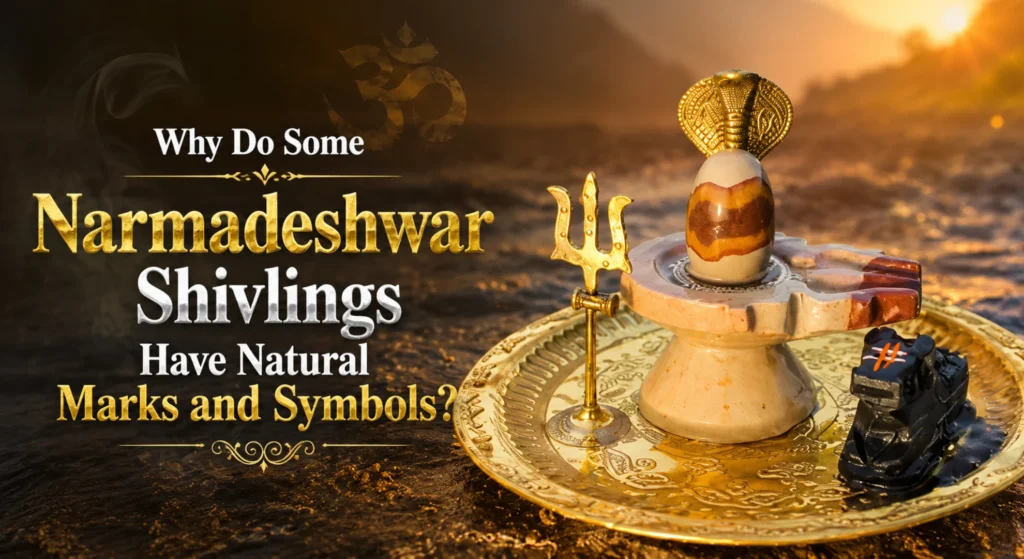
Many devotees feel fascinated when they notice unique lines, patterns, circles, stripes, or symbolic formations on a Narmadeshwar Shivling. Some of these markings resemble sacred symbols such as tilaks, rudraksha patterns, trishul-like shapes, or naturally occurring bands of different colors. Therefore, many people search for information about natural marks on Narmadeshwar Shivling to understand whether these formations hold spiritual meaning and how they develop naturally.
A Narmadeshwar Shivling forms in the sacred Narmada River through a natural process that takes thousands of years. Unlike carved stone idols, these Shivlings emerge through the continuous action of flowing water, minerals, pressure, and geological movement. As a result, every Narmadeshwar Shivling develops its own unique appearance, texture, and markings. Because no two stones experience exactly the same natural conditions, every Shivling becomes one of a kind.
You can explore authentic Narmadeshwar Shivling collections at
https://narmdeshwarshivling.com/
The term natural marks on Narmadeshwar Shivling refers to lines, bands, spots, color variations, mineral streaks, circular patterns, and symbolic formations that appear naturally on the surface of the stone. These marks are not painted, carved, or artificially created. Instead, nature produces them over long periods while the stone remains within the flowing waters of the Narmada River.
Some Shivlings display light-colored vertical lines that resemble a tilak. Others show layered bands of different shades, while some reveal unique textures that resemble sacred symbols. Because these formations occur naturally, devotees often view them as special characteristics that add uniqueness and spiritual beauty to the Shivling.
The formation of natural markings results from several geological processes working together over thousands of years. As river currents move stones along the riverbed, minerals settle on different parts of the surface. At the same time, pressure, friction, sediment deposits, and natural erosion continuously shape the stone.
Consequently, different mineral compositions create contrasting colors and visible patterns. Iron-rich minerals may create reddish or brown streaks, while other minerals can produce lighter or darker bands. Over centuries, these natural processes create the distinctive markings that devotees see on authentic Narmadeshwar Shivlings.
Because every stone travels a different path through the river, the resulting patterns always remain unique. Therefore, no two Narmadeshwar Shivlings look exactly alike.
Many devotees believe that naturally formed markings carry spiritual importance because nature creates them without human intervention. When devotees notice patterns resembling a tilak, trishul, rudraksha, serpent shape, or sacred stripe, they often interpret these formations as symbols connected with Lord Shiva.
Although the markings occur through natural geological processes, devotees appreciate their spiritual symbolism. Furthermore, naturally occurring patterns often strengthen the emotional and devotional connection between the worshipper and the Shivling.
For this reason, many devotees actively seek Shivlings with distinctive natural markings because they consider them especially meaningful for daily worship and meditation.
Among all natural marks on Narmadeshwar Shivling, tilak-like formations remain the most popular. These marks often appear as vertical lines running across the surface of the stone. In many cases, contrasting minerals create a lighter or darker stripe that resembles a traditional tilak used in Hindu worship.
Devotees frequently associate these markings with:
Because these patterns form naturally rather than through human craftsmanship, many devotees consider them highly auspicious.
Some Narmadeshwar Shivlings display markings that resemble sacred objects associated with Lord Shiva. For example, devotees occasionally identify formations that resemble the trishul, rudraksha beads, serpent patterns, or sacred geometric shapes.
These formations develop through natural mineral arrangements and surface textures. However, devotees often interpret them symbolically because they connect closely with traditional Shiva iconography.
Additionally, such patterns make each Shivling visually distinctive and spiritually meaningful for individual worshippers.
One interesting aspect of natural marks on Narmadeshwar Shivling is that they often indicate authenticity. Genuine Narmadeshwar Shivlings usually display natural textures, mineral bands, and organic surface variations because they form inside the Narmada River over long periods.
Authentic Shivlings commonly feature:
Therefore, natural markings often help distinguish authentic river-formed Shivlings from artificially manufactured products.
Unlike machine-made products, natural Shivlings never follow a standard design. Each stone experiences a unique geological journey through the Narmada River. Consequently, every Shivling develops different shapes, textures, colors, and markings.
This uniqueness creates a deeper connection for many devotees because they know their Shivling possesses characteristics that no other Shivling shares. Furthermore, natural diversity reflects the beauty and creativity of nature itself.
As a result, devotees often value naturally marked Shivlings for both their spiritual significance and their distinctive appearance.
Many spiritual practitioners use a Shivling as a focal point during meditation. Interestingly, natural markings sometimes help improve concentration because they provide a visual point of focus during prayer and contemplation.
When devotees meditate near a naturally marked Shivling, they often feel a stronger sense of personal connection with their spiritual practice. Additionally, the unique appearance of the stone can make meditation sessions more meaningful and engaging.
Therefore, many devotees prefer naturally marked Shivlings for both worship and meditation purposes.
Selecting an authentic Shivling remains important for traditional Shiva worship. Devotees generally look for naturally formed stones that display genuine textures, balanced shapes, and organic markings.
When choosing a Shivling, consider:
You can explore authentic options here:
https://narmdeshwarshivling.com/shop/
Natural markings enhance the beauty of a Shivling, while traditional offerings strengthen the worship experience. Bilva leaves remain among the most sacred offerings used during Shiva puja.
To learn more about their significance, you can read:
This guide explains why bilva leaves hold such an important place in Shiva worship traditions.
Proper care helps preserve the natural beauty and spiritual significance of a Shivling. Devotees should clean the Shivling gently with plain water after abhishek and dry it using a soft cloth.
Additionally, avoid harsh chemical cleaners because they may affect the natural mineral patterns and surface appearance. Regular maintenance helps keep the Shivling clean while preserving its original character.
Authenticity plays a crucial role when selecting a naturally marked Shivling. A trusted store ensures genuine Narmada River sourcing and traditional spiritual suitability.
Benefits include:
Visit
https://narmdeshwarshivling.com/
to explore authentic Narmadeshwar Shivling collections for worship, meditation, and spiritual practice.
They are naturally formed lines, patterns, mineral streaks, and symbols that develop during the stone’s formation in the Narmada River.
Yes. Natural tilak-like patterns form through mineral deposits and geological processes without human carving or painting.
Most authentic Shivlings display some level of natural texture, color variation, or mineral pattern, although every stone is different.
Many devotees consider them spiritually significant because nature creates the markings without human intervention.
You should purchase from a trusted store specializing in genuine Narmadeshwar Shivlings to ensure authenticity and spiritual quality.


Discover the divine power of authentic Narmadeshwar Shivlings, crafted from the sacred Narmada River stone.
+91-9165667897
luckykewat932@gmail.com
Bakawan Madhya Pradesh
Copyright © All Right Reserved